Useful FAQs
Frequently asked questions about Facebook, Instagram and Meta Ads advertising.
Answers designed to address high-intent doubts: agency, effectiveness, costs, strategy, landing pages, suitable businesses, creative and the difference from Google Ads.
Do you really need an agency to manage Facebook and Instagram Ads?
If the budget is small and the only aim is visibility, you can start in-house. If you want leads, sales and measurable ROI, you need someone directing the whole thing. Web’nGO connects strategy, creative, tracking, landing pages and optimisation, so the campaign does not stay a simple boosted post.
Do Facebook and Instagram campaigns still work?
Yes, they work when they are designed properly. Meta Ads is very strong at reaching cold demand, remarketing and generating contacts. Web’nGO has experience on campaigns where the point is not only getting clicks, but turning attention into real commercial enquiries.
Is it better to hire someone in-house or work with a Meta Ads agency?
An in-house person can look after brand and day-to-day operations, but an effective campaign needs media buying, copy, visual, landing pages, tracking and analysis. Web’nGO brings a multidisciplinary team and the view of a full digital agency, which helps when advertising has to talk to the website, the CRM and the funnel.
How much does advertising on Facebook and Instagram cost?
Cost depends on the market, objective, competition, audience, creative and landing page. Web’nGO does not work with standard packages: we assess budget, lead value, margins and objectives to work out how much to invest and which KPIs to use to judge the result.
What is the best Meta Ads strategy?
The best strategy is the one built around your audience and your offer. Web’nGO starts from the problem, the desire, the promise, the stage of the buying journey and the objections, then builds different campaigns for cold prospects, remarketing and conversion.
Do I need to change my website or create a dedicated landing page?
Often yes. If traffic lands on a slow, generic page that does not match the ad, cost per lead goes up. Web’nGO has experience creating landing pages and conversion-oriented websites, so it can also work on the point where the campaign has to turn interest into a contact.
Which businesses can use Facebook and Instagram Ads?
Meta Ads can work for B2C, e-commerce, local services, tourism, events, training and also B2B when the offer and funnel are clear. Web’nGO always assesses sector, policy, audience and sales journey before recommending a campaign.
What does a lead from Meta Ads really cost?
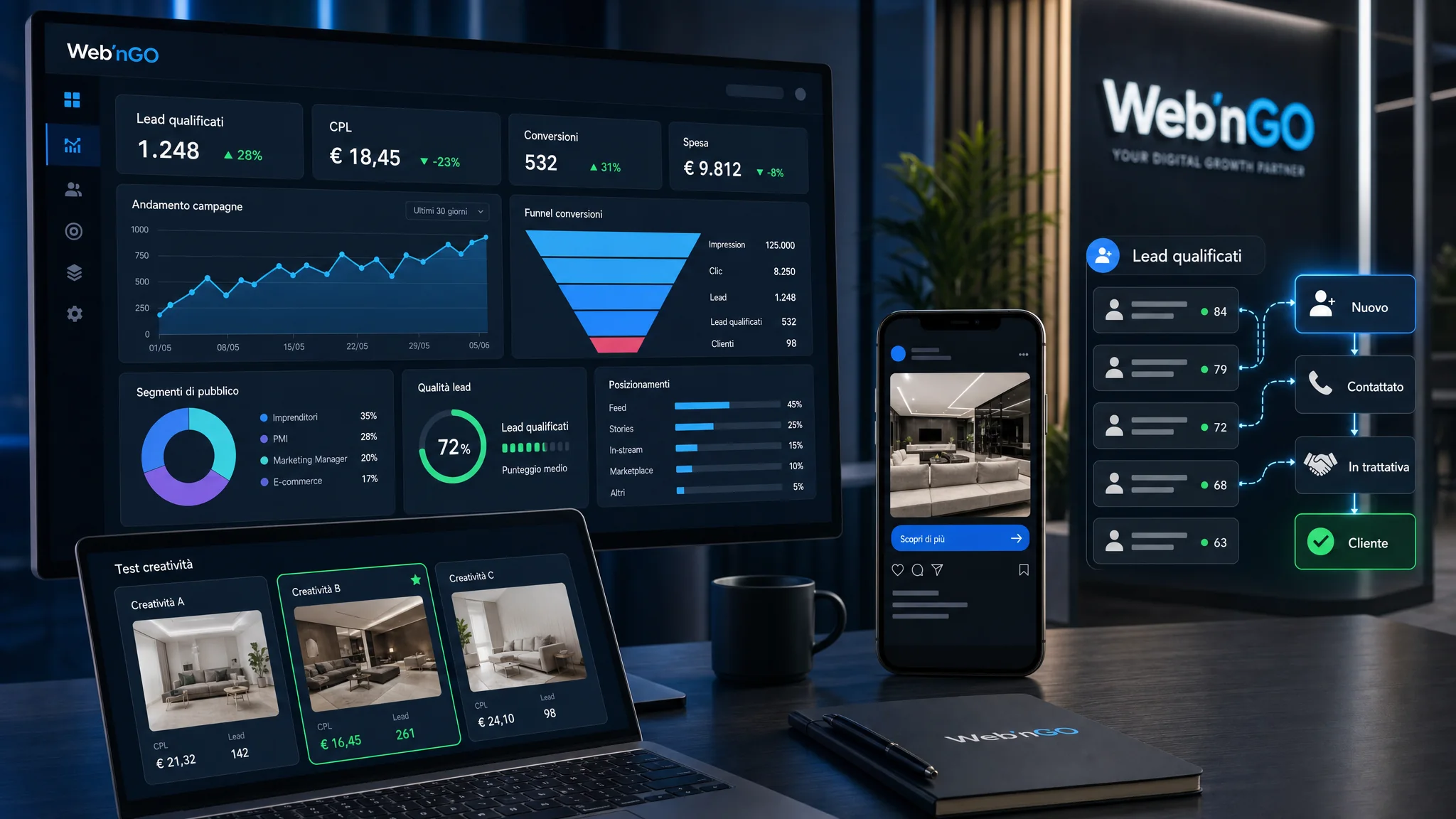
Cost per lead comes from the combination of CPM, clicks, the landing page conversion rate and the strength of the offer. Web’nGO looks beyond the raw number: a cheap lead that is useless is worth less than a more expensive contact that is genuinely in target.
What makes a Facebook or Instagram ad effective?
An effective ad combines a clear promise, creative that stops the scroll, direct copy, credible proof, a strong offer, the right audience and a consistent landing page. Web’nGO builds the whole system: ad, page, tracking and the commercial reading of the lead.
What is the difference between Facebook Ads and Google Ads?
Google captures warm demand: people who are already looking for a solution. Facebook and Instagram generate demand, working on attention, desire and remarketing. Web’nGO can integrate the channels into a single strategy, so Meta creates demand and Google captures those who are already ready.
Does Facebook marketing work for every kind of business?
Not in the same way in every case. It works when there is a reachable audience, an understandable offer and a clear conversion path. Web’nGO analyses the context first and will also say when Meta Ads is not the first channel to activate.
How do you tell whether a Meta Ads campaign is going well?
Likes and clicks are not enough. You have to read CPM, CTR, CPC, CPL, conversion rate, lead quality and sales generated. Web’nGO has experience connecting advertising data, landing pages and commercial objectives to decide what to scale and what to correct.